Greece — +30 698 557 8998
 Egypt — +20 111 3075 444
 Turkey — +90 506 022 30 00
 UAE — +971 52 913 5599





Opening a Greek bank account for foreigners is one of the earliest and most important steps when investing, relocating, or purchasing property in Greece. Whether you are applying for the Greece Golden Visa Program (Greek Residency by Investment Program) or simply managing financial transactions in the country, a local bank account is essential for compliance, efficiency, and long-term planning.
The Greece Golden Visa Program was introduced in 2013 to attract foreign investment into Greece, particularly in real estate and strategic sectors. Between 2024 and 2026, updated investment thresholds and stricter compliance requirements have made banking integration even more important for international investors.
According to GreeceGoldenVisa.com.gr, investors should secure their banking structure early to avoid delays in property acquisition, fund transfers, and residency processing.
A Greek bank account is typically required for:
- Property purchases and notary payments in Greece
- Greece Golden Visa investment transfers
- Utility payments and property maintenance
- Receiving rental income from Greek real estate
- Managing taxes and financial obligations in Greece
Why Foreigners Need a Greek Bank Account
Foreign investors and expats usually need a local bank account because most property and investment transactions in Greece must pass through regulated Greek banking channels.
Key scenarios include:
- Property purchase in Greece through a Greek IBAN
- Greece Golden Visa investment compliance
- Utility bills, taxes, and property expenses
- Rental income collection
- Coordination with lawyers, notaries, and developers
The Greek banking system operates under EU financial regulations, which means transactions are subject to KYC (Know Your Customer) and AML (Anti-Money Laundering) standards.
Key advantages include:
- Faster SEPA transfers
- Lower transfer costs than some international routes
- Improved legal and financial traceability
- Easier coordination during real estate transactions
Who Can Open a Bank Account in Greece
Opening a Greek bank account is not limited to Greek residents. Both residents and non-residents may qualify if they meet compliance and documentation requirements.
Eligible applicants include:
- Non-resident investors purchasing Greek property
- Greece Golden Visa applicants
- Expats relocating for business or lifestyle
- International entrepreneurs managing EU operations
Major institutions such as National Bank of Greece, Piraeus Bank, Alpha Bank, and Eurobank offer services for foreign investors.
Requirements often vary depending on:
- Residency status
- Country of origin
- Source of funds
- Investment purpose
For many investors, combining AFM registration, bank account setup, and Greece Golden Visa Program planning at the same stage creates a smoother process.
Do You Need Residency to Open a Greek Bank Account?
A common investor question is whether a Greek residence permit is required before opening an account.
The practical answer:
- No, residency is not always required
- Yes, non-residents face stricter compliance checks
Non-residents can generally open a Greek bank account, but banks often require:
- Clear financial purpose (such as property investment)
- Detailed source of funds verification
- AFM registration
- Additional due diligence documentation
In many Greece Golden Visa cases, investors open their bank account before obtaining residency because:
- Property purchases often require a Greek banking channel
- Investment funds must be traceable
- Banking compliance supports residency compliance
Greek Tax Number (AFM) Requirement for Bank Accounts
Before opening a Greek bank account, obtaining a Greek Tax Number (AFM) is usually mandatory.
The AFM is issued by AADE (Independent Authority for Public Revenue) and functions as your financial identity within Greece.
Without an AFM, investors generally cannot:
- Open a Greek bank account
- Buy property in Greece
- Complete Greece Golden Visa investment
- Register utilities or major contracts
What Is an AFM in Greece?
AFM (Arithmos Forologikou Mitroou) is Greece’s tax identification number.
It is required for:
- Banking transactions
- Property purchases
- Tax reporting
- Golden Visa investment activities
For investors, AFM registration is one of the first practical gateways into the Greek financial system.
How to Get an AFM as a Foreigner
Foreign investors can usually obtain an AFM relatively quickly through:
- Passport submission
- Application form completion
- Tax representative appointment (for many non-residents)
- Address documentation where required
Many investors use Power of Attorney so legal representatives can complete this remotely.
AFM Requirements for Property Investors
For real estate investors, AFM is mandatory.
You need it to:
- Sign purchase agreements
- Transfer funds through Greek banks
- Register property ownership
- Apply for Greece Golden Visa residency
Greece Golden Visa Investment Options (2026)
| Investment Tier | Applies To |
|---|---|
| €250,000 | Commercial-to-residential conversions |
| €400,000 | Standard qualifying regional real estate |
| €800,000 | Athens, Thessaloniki, Mykonos, Santorini |
Every route depends on financial traceability through a Greek bank account connected to your AFM.
Documents Required to Open a Bank Account in Greece
Greek banks apply strict KYC and AML procedures, so documentation must be organized carefully.
Typical required documents include:
- Valid passport or ID
- Proof of address
- Greek Tax Number (AFM)
- Proof of income or source of funds
- Tax returns or financial statements in some cases
Valid Passport or ID
Banks require primary identity verification.
This is used for:
- Identity confirmation
- Nationality verification
- EU compliance checks
Proof of Address
Accepted examples often include:
- Utility bills
- Bank statements
- Rental agreements
Non-residents may use foreign addresses, though additional checks are common.
Greek Tax Number (AFM) Certificate
AFM is typically mandatory for banking approval and links the account to the Greek tax system.
Proof of Income or Source of Funds
Banks often request documentation showing how funds were generated.
Examples include:
- Employment income
- Business ownership
- Investment returns
- Asset sale proceeds
Tax Returns and Financial Statements
Higher-value investors or business owners may face deeper due diligence, especially when transferring significant capital for Greece Golden Visa properties or major acquisitions.
KYC and Compliance Checks for Greek Bank Accounts
Opening a Greek bank account for foreigners involves strict regulatory checks designed to ensure transparency and compliance with Greek and EU financial laws.
All major Greek banks operate under Bank of Greece supervision and broader European regulatory frameworks. This means account opening may take anywhere from several days to a few weeks depending on your financial profile, country of origin, and investment structure.
Greek banks apply these checks to:
- Verify identity and legal status
- Confirm legitimacy of financial activity
- Prevent money laundering and fraud
- Ensure traceability of investment funds
For investors, especially those transferring funds for property acquisition or Greece Golden Visa investment, these checks are a normal but important part of the process.
Know Your Customer (KYC) Requirements
KYC is the first major compliance stage.
Greek banks generally require:
- Passport or national ID verification
- Residential address confirmation
- Professional or business activity verification
- Completion of internal banking declarations
Additional checks may apply if:
- You are a non-resident
- Your financial structure is international
- Your funds come from multiple sources
- You are transferring significant capital
This process applies to both residents and non-residents, though foreign investors often face deeper scrutiny.
Anti-Money Laundering (AML) Compliance
Greek banks also follow strict AML directives aligned with EU law.
AML procedures may include:
- Screening against international sanctions lists
- Wealth and transaction pattern review
- Verification of declared financial activity
- Monitoring of large deposits and transfers
For Golden Visa investors, AML review is especially important because qualifying investments must be fully transparent.
Source of Funds Verification
Source of funds verification is often one of the most time-consuming parts of the banking process.
Banks typically require documentation proving how your funds were generated.
Accepted examples may include:
- Salary and employment contracts
- Business ownership documents
- Company profits
- Investment returns
- Asset sales
- Inheritance records
This step is particularly important for:
- Property purchases
- Greece Golden Visa investment
- Large capital transfers into Greece
Proper preparation here can significantly reduce delays.
Step-by-Step Process to Open a Bank Account in Greece
Opening a bank account in Greece follows a structured process. Understanding each stage helps investors reduce friction and improve efficiency.
Step 1: Obtain a Greek Tax Number (AFM)
The first and mandatory step is securing your AFM.
Without it, you generally cannot:
- Open a bank account
- Buy property
- Complete Golden Visa investment
- Register major financial activity
Many foreign investors complete this remotely through Power of Attorney.
Step 2: Choose the Right Bank in Greece
Selecting the right bank matters, especially for foreign investors.
Major banking institutions include:
- National Bank of Greece
- Piraeus Bank
- Alpha Bank
- Eurobank
When comparing options, consider:
- Foreign investor experience
- Golden Visa familiarity
- English-speaking support
- Digital banking capabilities
- International transfer efficiency
Step 3: Submit Documentation and KYC Forms
Once a bank is selected, you submit all required documentation.
This usually includes:
- Passport
- Proof of address
- AFM certificate
- Financial records
- Source of funds documentation
The bank then begins compliance review.
Step 4: Deposit Initial Funds and Activate the Account
After approval:
- Your Greek IBAN is issued
- Online banking access is activated
- Initial funding can begin
- Property transaction readiness improves
This step is especially important for investors preparing for property due diligence in Greece because legal and financial coordination often begins immediately afterward.
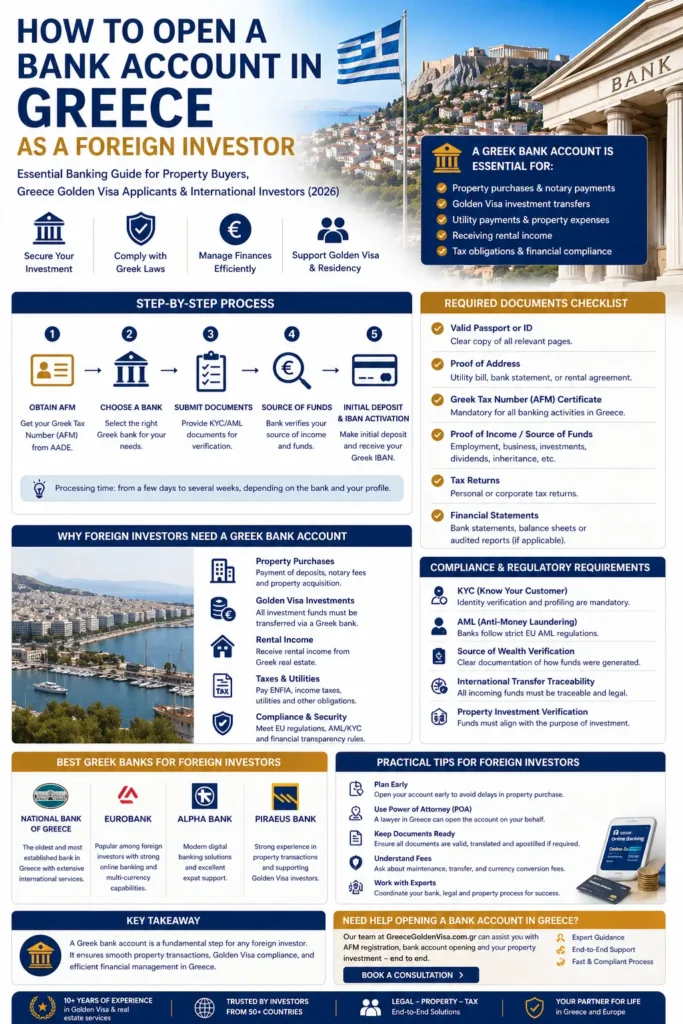
Best Banks in Greece for Foreigners and Investors
Choosing the right financial institution can significantly affect banking speed, compliance experience, and long-term usability.
National Bank of Greece (NBG)
NBG is one of Greece’s oldest and most established banks.
It is often preferred for:
- Institutional stability
- Broad branch network
- Conservative banking reliability
Piraeus Bank
Piraeus Bank is commonly used by investors active in real estate.
Advantages include:
- Strong real estate transaction experience
- Familiarity with property investors
- Golden Visa support in many cases
Alpha Bank
Alpha Bank is often favored by expats and remote investors.
Key strengths:
- Strong digital banking tools
- Online usability
- International-friendly systems
Eurobank
Eurobank is particularly popular among international investors.
Advantages include:
- Multi-currency capabilities
- International transfer strength
- Experience with foreign clients
- Strong cross-border support
For many investors, the “best” bank depends less on brand and more on:
- Compliance profile
- Country of origin
- Property goals
- Transfer structure
- Banking convenience
Opening a Greek Bank Account Online
A common question is whether foreigners can open a Greek bank account entirely online.
The practical answer is: partially.
Current reality:
- Some banks allow online pre-application
- Identity verification may still require video or in-person checks
- Full remote onboarding may be limited for some non-residents
Because of this, many investors use a hybrid model.
Opening a Bank Account by Power of Attorney
Power of Attorney (POA) is one of the most efficient solutions for foreign investors.
This allows:
- A Greek lawyer to act on your behalf
- AFM registration remotely
- Bank document preparation
- Compliance coordination
- Reduced travel burden
For Greece Golden Visa applicants, this approach is especially common because it aligns banking, legal setup, and investment preparation efficiently.
Digital Banking Options in Greece
Greek banking has improved significantly in digital functionality.
Modern digital banking features often include:
- Online account management
- Mobile banking apps
- SEPA payments
- International transfers
- Multi-currency support
However, digital banking does not replace initial compliance requirements.
In practice:
- Daily management can be highly digital
- Initial setup remains compliance-heavy
- Professional support can accelerate onboarding significantly.
Using a Greek Bank Account for Property Investment
A Greek bank account is a core part of almost every real estate investment strategy in Greece, especially for investors pursuing the Greece Golden Visa Program.
Because the Greece Golden Visa Program is primarily linked to qualifying real estate or strategic investments, Greek banking integration is not simply practical, it is often necessary for compliance.
Bank Accounts for Real Estate Transactions
When purchasing property in Greece, most financial transactions must move through regulated banking channels.
This generally includes:
- Transferring funds into a Greek IBAN
- Coordinating with notaries and lawyers
- Completing legally traceable payments
- Registering financial activity under your AFM
This process helps ensure:
- Legal property registration
- Full financial traceability
- Compliance with Greek and EU regulations
- Golden Visa eligibility support
Without proper banking coordination, property transactions can face delays or compliance complications.
Escrow and Property Payment Procedures
Greek real estate transactions often involve structured legal payment procedures coordinated with notaries and legal representatives.
Typical structure:
- Funds transferred into the investor’s Greek bank account
- Legal due diligence completed
- Notary verifies documentation
- Payment executed upon contract completion
- Ownership registered with the Greek Land Registry
This protects both investor and seller while ensuring compliance.
For foreign investors, this structure is especially important because it links property, banking, legal, and residency procedures into one coordinated process.
Bank Account Requirements for the Greece Golden Visa
A Greek bank account is generally essential for Golden Visa applicants because qualifying investments must be financially transparent.
Investors typically need to:
- Transfer qualifying funds through Greek banking channels
- Maintain transaction records
- Link financial activity to AFM
- Demonstrate source of funds
Greece Golden Visa Investment Options (2026)
| Investment Tier | Applies To |
|---|---|
| €250,000 | Commercial-to-residential conversions / listed restoration |
| €400,000 | Standard qualifying real estate |
| €800,000 | Athens, Thessaloniki, Mykonos, Santorini |
Each route requires legal banking traceability to support both property registration and residency compliance.
Banking Fees and Costs in Greece
Understanding Greece banking costs is important for investors planning long-term financial operations.
While Greek banks are generally cost-efficient compared to some global jurisdictions, fees still vary by institution and account structure.
Account Maintenance Fees
Typical costs may include:
- Monthly or quarterly maintenance charges
- Administrative service fees
- Statement or account servicing fees
These are usually manageable but should still be factored into ongoing property ownership planning.
Transfer and Currency Exchange Fees
Foreign investors often incur:
- SEPA transfer fees
- SWIFT international transfer fees
- Currency conversion fees for non-euro transfers
Because Golden Visa and property investments often involve substantial capital movement, choosing a bank with efficient transfer structures can reduce long-term costs.
ATM and Card Usage Fees
Additional daily banking costs may include:
- ATM withdrawal fees
- Debit card issuance fees
- Renewal fees
- International transaction charges
For investors managing rental property or spending time in Greece, these operational costs can influence bank selection.
Practical Banking Tips for Foreign Investors in Greece
Navigating Greek banking efficiently requires more than document preparation. Strategic choices can improve speed, reduce cost, and simplify future transactions.
Choosing the Right Bank for Property Transactions
Not all Greek banks offer the same experience for foreign investors.
Key factors to evaluate:
- Golden Visa familiarity
- Speed of KYC/AML processing
- International transfer capability
- English-speaking support
- Digital banking quality
- Property transaction experience
For many investors, property-related banking efficiency matters more than branch size alone.
Working With Lawyers and Financial Advisors
Opening a Greek bank account often overlaps with:
- AFM registration
- Property acquisition
- Notary coordination
- Golden Visa preparation
Working with legal and financial advisors can help:
- Avoid document inconsistencies
- Accelerate compliance
- Coordinate banking and property stages
- Reduce administrative friction
This is particularly useful for investors using remote structures through Power of Attorney.
Managing International Transfers to Greece
International fund transfers are one of the most important operational elements of Greek investment planning.
Best practices include:
- Using SEPA where possible
- Planning exchange rates in advance
- Coordinating transfer timing with legal milestones
- Keeping clear source-of-funds records
- Avoiding fragmented or unclear transfer structures
For investors preparing broader relocation or investment planning, integrating banking with Power of Attorney for Greece can often simplify the process significantly.
Frequently Asked Questions About Opening a Bank Account in Greece
How to open a bank account in Greece as a foreigner?
Foreigners typically need an AFM (Greek Tax Number), passport, proof of address, and financial documentation, followed by KYC and AML approval.
Can foreigners open bank accounts in Greece?
Yes, both residents and non-residents can generally open Greek bank accounts if they satisfy compliance and documentation requirements.
What documents do you need to open a bank account in Greece?
Common requirements include a passport, proof of address, AFM certificate, and source of funds documentation.
What are the best banks in Greece for foreigners?
Popular choices often include National Bank of Greece, Eurobank, Alpha Bank, and Piraeus Bank depending on investor needs.
Can I open a Greek bank account online?
Some banks offer partial online onboarding, but full compliance verification may still require in-person confirmation or Power of Attorney.
Do I need a bank account to buy property in Greece?
Yes, in most cases a Greek bank account is necessary for compliant property purchases and Golden Visa investment structures.
How long does it take to open a bank account in Greece?
It can range from several days to a few weeks depending on documentation quality and compliance complexity.
Can investors open a Greek bank account remotely?
Yes, many investors use lawyers and Power of Attorney to complete AFM registration and banking setup remotely.