Greece — +30 698 557 8998
 Egypt — +20 111 3075 444
 Turkey — +90 506 022 30 00
 UAE — +971 52 913 5599





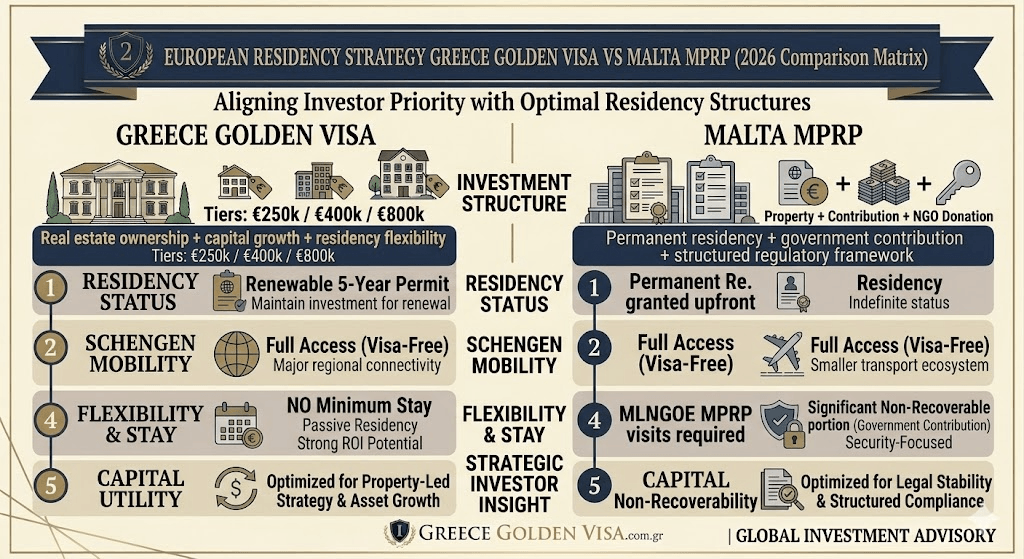
The Greece Golden Visa Program and the Malta Permanent Residence Programme (MPRP) are two of Europe’s most discussed residency-by-investment options for non-EU investors seeking access to the European Union and the Schengen Area. Both provide European residency through investment, but they operate under fundamentally different investment structures.
The Greece Golden Visa Program, introduced in 2013 by the Hellenic Republic, focuses heavily on real estate acquisition and allows investors to secure a renewable residence permit through qualifying property investments. Malta, by contrast, uses a structured residency model that combines property obligations, government contributions, and strict due diligence to grant permanent residency.
Core Strategic Difference:
Greece:
Real estate ownership + capital growth + residency flexibility
Malta:
Permanent residency + government contribution + structured regulatory framework
For investors, the choice often depends on:
- Property ROI potential
- Residency stability
- Schengen mobility
- Family security
- Exit strategy
- Capital preservation
For investors exploring Greek residency through strategic property ownership, Greece often appeals more strongly to those prioritizing tangible assets and market upside.
What Is the Greece Golden Visa Program?
The Greece Golden Visa Program is a residency-by-investment scheme that allows eligible non-EU investors to obtain a renewable five-year residence permit through qualifying real estate investment. It remains one of Europe’s strongest property-driven residency options.
Greece Golden Visa Investment Thresholds (2026)
| Investment Route | Threshold |
|---|---|
| Commercial-to-residential conversion projects | €250,000 |
| Standard real estate investments in designated regions | €400,000 |
| Premium zones such as Attica, Thessaloniki, Santorini | €800,000 |
Major Benefits:
- No minimum stay requirement
- Direct real estate ownership
- Potential rental income
- Schengen Area access
- Broad family inclusion
- Lower entry point than many EU alternatives
Key Investor Markets:
- Athens
- Attica
- Thessaloniki
- Santorini
- Greek islands
This structure is particularly attractive for investors seeking EU residency through a recoverable, asset-backed strategy.
For buyers exploring qualifying Greek investment properties, Greece remains one of Europe’s most diverse property-led residency markets.
What Is the Malta Permanent Residence Programme (MPRP)?
The Malta Permanent Residence Programme is a government-regulated residency scheme that grants permanent residency through a combination of:
- Property purchase or lease
- Government contribution
- NGO donation
- Administrative fees
- Due diligence compliance
Unlike Greece, Malta is not fundamentally structured around real estate ROI.
Malta MPRP Core Characteristics:
- Permanent residency from the outset
- Schengen travel rights
- Strict due diligence
- Higher non-recoverable costs
- Smaller property market
- Structured legal framework
Key Investor Reality:
A significant portion of Malta’s total cost is non-recoverable due to government contributions.
This makes Malta more residency-security focused than investment-growth focused.
Malta vs Greece Residency Programs: Key Structural Differences
| Factor | Greece Golden Visa | Malta MPRP |
|---|---|---|
| Investment Type | Real estate ownership | Property + government contribution |
| Residency Type | Renewable residence permit | Permanent residency |
| Investment Recovery | Potential resale | Partial non-recoverable |
| Market Size | Large and diverse | Smaller and limited |
| Flexibility | High | Moderate |
Strategic Investor Insight:
Greece generally emphasizes:
Asset growth + property control
Malta generally emphasizes:
Residency stability + regulatory structure
Investment Requirements Comparison
Greece:
Investment Model:
Primarily property ownership
Advantages:
- Tangible asset
- Rental potential
- Capital appreciation
- Recoverable through resale
Malta:
Investment Model:
Property + contributions + donations
Advantages:
- Permanent residency status
- Structured process
Limitations:
- Higher total effective cost
- Non-recoverable capital components
- Smaller investment scalability
Bottom Line:
For wealth preservation and property-led investment, Greece often offers stronger capital utility.
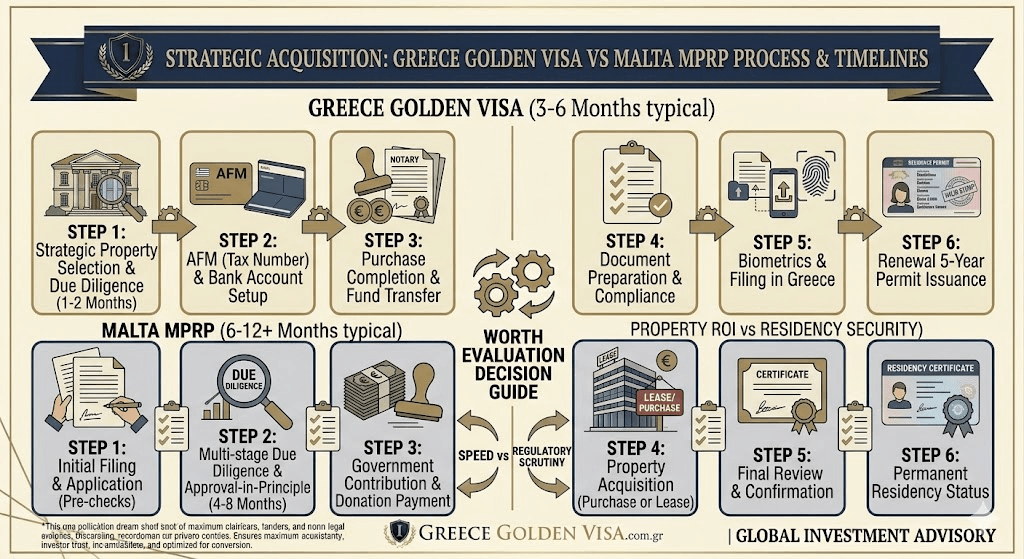
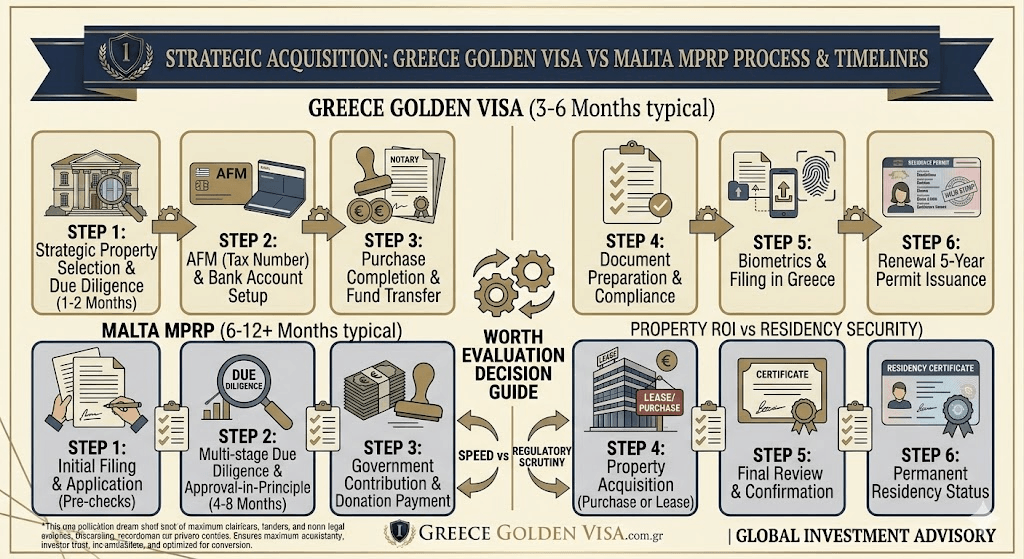
Processing Time and Application Timeline
Greece Golden Visa:
Typical Timeline:
- Property acquisition: 1–2 months
- Legal checks: 2–4 weeks
- Biometrics + filing
- Approval: 3–6 months
Malta MPRP:
Typical Timeline:
- Initial filing
- Multi-stage due diligence
- Financial review
- Property commitment
- Approval: 6–12 months or longer
Strategic Insight:
Greece often provides faster operational access, while Malta prioritizes regulatory scrutiny.
Residency Requirements and Minimum Stay
Greece:
Major Competitive Advantage:
No minimum stay requirement
Investor Benefits:
- No forced relocation
- Global mobility preserved
- Simple 5-year renewals
Malta:
Advantages:
- Permanent residency
- Stable structure
Key Consideration:
- More ongoing compliance oversight
Bottom Line:
For investors seeking maximum flexibility, Greece generally offers a more passive residency structure.
Travel and Mobility Benefits: Greece vs Malta
Both programs provide Schengen mobility, which is a major strategic benefit.
Greece:
Advantages:
- Visa-free Schengen travel
- Athens as a stronger travel hub
- Better geographic connectivity
- Stronger regional infrastructure
Malta:
Advantages:
- Schengen travel rights
- EU access
Limitation:
- Smaller geographic footprint
- More limited transportation ecosystem
Strategic Insight:
Both offer Schengen, but Greece may offer stronger practical mobility for frequent travelers.
Property Investment Opportunities in Greece vs Malta
This is often the defining factor for investors.
Greece Property Market
Key Strengths:
Athens:
- Urban regeneration
- Rental demand
Thessaloniki:
- Lower entry
- Economic growth
Islands:
- Tourism upside
- Lifestyle prestige
Advantages:
- Larger market
- Greater diversity
- Higher portfolio scalability
- Better ROI potential
For investors evaluating Athens and Thessaloniki property strategy, Greece often offers significantly broader real estate flexibility.
Malta Property Market
Strengths:
- Stable legal market
- Structured property compliance
Limitations:
- Smaller supply
- Higher concentration
- More limited scalability
- Property often secondary to residency objective
Bottom Line:
For real estate-focused investors, Greece generally offers stronger property upside.
Family Inclusion and Residency Rights
Greece:
Eligible Family Members:
- Spouse
- Children under 21
- Students up to 24 in certain cases
- Parents of applicant
- Parents of spouse
Strategic Advantage:
One of Europe’s strongest multi-generational frameworks.
Malta:
Eligible Family Members:
- Spouse
- Dependent children
- Some dependent parents/grandparents under conditions
Key Consideration:
Generally more documentation-heavy.
Investor Insight:
For broader family inclusion with simpler structure, Greece often has the advantage.
Tax Considerations: Greece vs Malta
Greece:
Strengths:
- Non-dom incentives
- Property investor flexibility
- Capital gains suspension through 2026 in certain contexts
- Residency ≠ automatic tax residency
Malta:
Strengths:
- Remittance-based taxation
- Strong international tax reputation
- Corporate structuring appeal
Bottom Line:
Malta may appeal more strongly to tax planners, while Greece often balances residency + property + tax flexibility.
Citizenship Pathway: Greece vs Malta
Greece:
Path:
- 7 years legal residency
- Physical presence
- Greek language
- Integration
Malta:
Path:
- Separate legal pathways
- Residency ≠ automatic citizenship
- Additional frameworks apply
Strategic Difference:
Neither is a direct citizenship-by-investment route, but Greece offers a clearer standard naturalization path through residency.
Advantages of the Greece Golden Visa
Major Strengths:
- Lower entry thresholds
- Real estate ROI
- No minimum stay
- Fast processing
- Broader family inclusion
- Large real estate market
Advantages of Malta MPRP
Major Strengths:
- Permanent residency
- Regulatory stability
- Strong due diligence
- Structured legal environment
Which Residency Program Is Better for Different Investors?
Choose Greece If You Prioritize:
- Real estate ownership
- Rental income
- Lower cost
- Flexibility
- Schengen + property strategy
Choose Malta If You Prioritize:
- Permanent residency security
- Structured legal system
- Regulatory framework
- Smaller-state stability
Final Verdict: Malta or Greece for Residency by Investment?
For most investors seeking:
Property + flexibility + capital growth:
Greece often provides the stronger strategic model.
For investors seeking:
Permanent residency + structured compliance:
Malta may be more suitable.
Bottom Line:
Greece often appeals more strongly to investors seeking a residency strategy that also functions as an investment strategy.
Frequently Asked Questions
Malta vs Greece Golden Visa: which is better?
It depends on whether your priority is property ROI and flexibility (Greece) or permanent residency and structure (Malta).
Does Greece offer Schengen access?
Yes, Greece Golden Visa holders receive Schengen mobility.
Does Malta provide permanent residency?
Yes, Malta’s program grants permanent residency.
Which offers better property investment opportunities?
Greece generally offers a larger and more diverse real estate market.
Which is cheaper?
Greece often has lower effective entry cost, especially when considering Malta’s non-recoverable contributions.