Greece — +30 698 557 8998
 Turkey — +90 506 022 30 00
 UAE — +971 52 913 5599
 Egypt — +20 110 114 9411



Opening a Greek bank account is one of the most important administrative steps in the Greece Golden Visa investment process. Without it, completing the qualifying property purchase or financial investment required for residency is not possible.
Greek banks operate under strict European financial regulations, including Know Your Customer (KYC) and Anti Money Laundering (AML) requirements. These compliance procedures are designed to verify the identity of international investors and ensure the legitimacy of the funds used for Golden Visa investments.
For investors applying in 2026, understanding how the Greek banking system works can significantly reduce delays during the property acquisition phase.
This guide explains the complete process of opening a Greek bank account as a non resident investor, including documentation requirements, Source of Funds verification, and the two available methods for opening the account. If you are still exploring the investment program itself, you may first review the full Greece Golden Visa Program guide on our website before preparing the banking step.

Investor’s Quick Brief
- Prerequisite for Investment: You cannot complete the Golden Visa property purchase or investment without a Greek bank account in the primary applicant’s name. The investment funds must be transferred from this account.
- AFM is Mandatory First: Before approaching any bank, you must first obtain a Greek Tax Identification Number (Arithmos Forologikou Mitroou – AFM). This is a non-negotiable requirement.
- Two Paths Available: The account can be opened in-person with a pre-arranged appointment or remotely through a limited Power of Attorney (PoA) granted to your legal representative in Greece.
- Source of Funds is Key: Be prepared for intense scrutiny of your Source of Funds (SoF). A clear, well-documented declaration proving the legitimate origin of your investment capital is the most critical part of the application.
- Major Banks are Prepared: Greece’s systemic banks (National Bank of Greece, Piraeus Bank, Alpha Bank, Eurobank) are experienced in handling Golden Visa applications and have dedicated processes for non-resident clients.
- Compliance is Global: The extensive documentation required is not unique to Greece; it reflects global standards like the Common Reporting Standard (CRS) and FATCA, designed to ensure financial transparency.
The Strategic Importance of a Greek Bank Account for Your Investment
The Greek government mandates that the qualifying investment for the Golden Visa must be paid through a local financial institution. This serves two purposes:
- Traceability and Compliance: It creates a clear, auditable trail for the migration authorities, proving that the funds originated from the applicant and were used for the specified investment, satisfying AML regulations.
- Economic Integration: It formally integrates the investor’s capital into the Greek financial system.
Attempting to pay a seller directly from a foreign account will invalidate the transaction for Golden Visa purposes. The Greek bank account is the official, required gateway.
Why Greek Banks Require Detailed Compliance Checks
International investors are often surprised by the level of documentation required by Greek banks. However, these requirements are part of the broader European financial compliance framework.
Greek banks must comply with several international regulations, including:
-
EU Anti Money Laundering Directives
-
FATCA reporting obligations for US citizens
-
Common Reporting Standard (CRS) for global tax transparency
Because Golden Visa investments frequently exceed €250,000 or €800,000 depending on the property zone, banks must conduct enhanced due diligence for non resident clients.
This review focuses primarily on two areas:
Identity verification
Banks confirm the investor’s identity, residency status, and professional activity.
Source of Funds verification
Compliance teams must confirm that the investment capital originates from legitimate and traceable financial activity.
This process may seem extensive, but it protects both the banking system and the investor. It also ensures that the funds used for the residency investment will be fully accepted by the immigration authorities when submitting the Golden Visa residency application.
Choosing the Right Financial Institution: Key Considerations for Investors
While several banks operate in Greece, HNWIs should focus on the four systemic banks due to their stability, extensive networks, and experience with international clientele.
- National Bank of Greece (NBG)
- Piraeus Bank
- Alpha Bank
- Eurobank
Key considerations when choosing:
- Experience with Golden Visa clients: Inquire if the specific branch has a department or relationship managers experienced with non-resident investors.
- Digital Banking Platform: Assess the quality and security of their online and mobile banking services for remote account management.
- Language Support: While most major branches have English-speaking staff, confirming this is prudent.
- Fee Structure: Understand the fees for account maintenance, international transfers (SWIFT), and any premium banking services.
The Two Paths to Opening an Account: In-Person vs. Remote
Investors have two options for opening the account, each with its own process.
Path A: The In-Person Application
This is the most direct method.
- Obtain AFM: Your lawyer first secures your Greek Tax Number.
- Schedule Appointment: Your lawyer schedules an appointment at a bank branch. Walk-in applications for non-residents are highly discouraged.
- Attend Meeting: You attend the meeting with your lawyer, bringing your passport and all other required documents. The process typically takes 1-2 hours.
- Account Activation: The account is usually activated within a few business days.
Path B: The Remote Application via Power of Attorney (PoA)
This is the most common path for busy investors.
- Execute a Limited PoA: You grant a limited Power of Attorney to your Greek lawyer, specifically authorizing them to open a bank account on your behalf. This PoA must be notarized and carry an Apostille stamp.
- Lawyer Secures AFM: Your lawyer uses the PoA to obtain your AFM.
- Lawyer Represents You at Bank: Your lawyer presents the Apostilled PoA and all your documentation to the bank to complete the application process.
- Receive Credentials Securely: Once the account is open, the bank will provide the debit card and online banking credentials to your lawyer, who will then courier them to you securely.
The Core Documentation Checklist: Preparing for Success
Preparation is paramount. While requirements may vary slightly between banks, the core list is consistent.
For the Individual Applicant
- Valid Passport: Clear copy for all named account holders.
- Greek Tax Identification Number (AFM): The official certificate of issuance.
- Proof of Address: A recent utility bill (electricity, water, landline phone) or bank statement from your home country, clearly showing your name and residential address. It must be officially translated into Greek or English.
- Proof of Occupation/Income: A letter from your employer, recent payslips, or a letter from your accountant detailing your professional activity.
- Contact Information: A mobile phone number (a Greek number is often required for verification codes).
- Source of Funds (SoF) Declaration: A detailed statement and supporting evidence (see next section).
For Corporate Entities (if applying as CEO/shareholder)
If your funds are coming from a company you own, be prepared to provide a full suite of corporate documents (Certificate of Incorporation, Articles of Association, Shareholder Registry), all notarized, Apostilled, and officially translated.
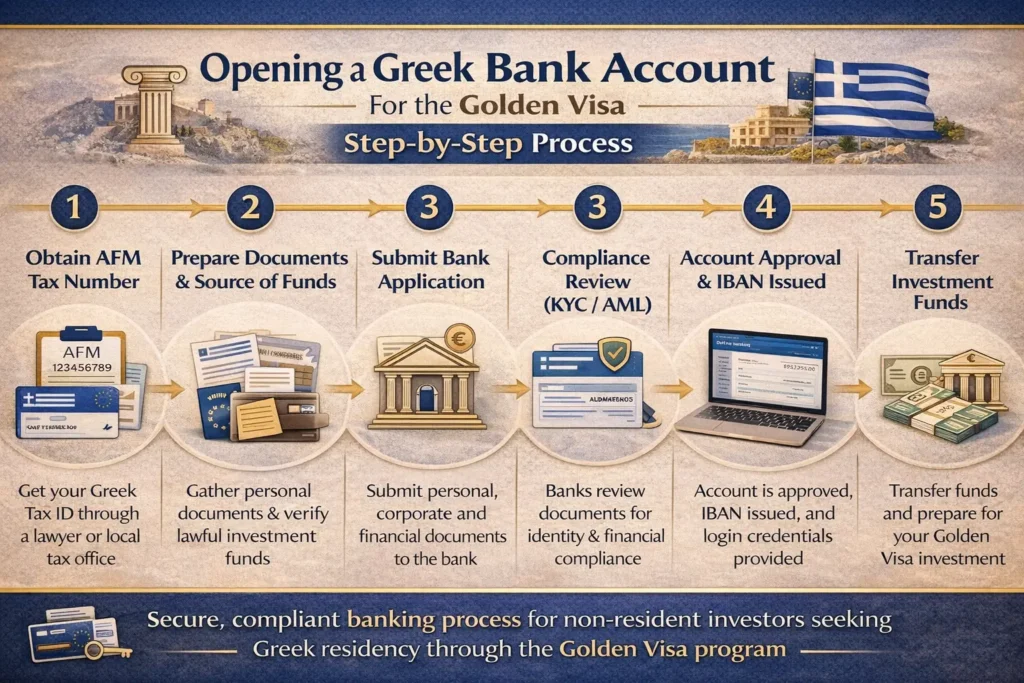
The Critical Hurdle: The Source of Funds (SoF) Declaration
This is the most scrutinized part of the application. You must prove, with verifiable evidence, that your investment capital was acquired legally.
Why Banks Scrutinize SoF
Greek banks are legally obligated to prevent money laundering. They must report all large and suspicious transactions. An €800,000 transfer from a new non-resident client automatically triggers a high level of review. A weak SoF declaration is the number one reason for rejection or delay.
Crafting a Compelling SoF Narrative
Your SoF declaration should be a clear story backed by documents. Common legal sources of funds and the required evidence include:
- Salary/Business Income: Tax returns for the last 3-5 years, audited financial statements for your business, and personal bank statements showing accumulated savings.
- Sale of Property: The final sale deed for the property, a tax clearance certificate for the sale, and a bank statement showing the deposit of the proceeds.
- Sale of Shares/Company: The share purchase agreement, evidence of the company valuation, and bank statements showing receipt of funds.
- Dividends: Corporate resolutions declaring the dividend distribution, company financial statements, and personal bank statements showing receipt of the dividend payments.
- Inheritance or Gift: The notarized will or gift deed, a tax certificate proving any inheritance/gift tax was paid, and legal proof of your relationship to the benefactor.
The Process Step-by-Step
- Engage a Lawyer & Grant PoA (if remote): Select your legal representative.
- Obtain AFM: Your lawyer secures your tax number. This is Step 1.
- Gather & Translate Documents: Compile the full checklist of documents, ensuring official translations where required.
- Submit Application: Either you or your lawyer submits the complete file to the chosen bank.
- Bank Review & Compliance Check: The bank’s compliance department reviews the file, focusing on KYC and the SoF. They may request additional clarification.
- Account Approval & Opening: Upon approval, the account is opened, and an IBAN is issued.
- Fund the Account: Transfer the investment amount into your new Greek account. It is advisable to transfer a slightly larger amount to cover bank charges and property purchase fees.
How the Bank Account Connects to the Golden Visa Application
Opening the bank account is only one part of the overall Golden Visa investment process. Once the account is active, it becomes the financial gateway for completing the qualifying investment.
The funds transferred into the account will be used for the official property payment recorded in the notarial deed. This payment record later becomes part of the residency application file submitted to the Greek immigration authorities.
Investors who are still evaluating property options may find it useful to review our guide on best places to invest in Greece for Golden Visa, which explains how different cities and regions influence long term property performance.
Similarly, understanding the full documentation process can help investors prepare their files more efficiently. Our detailed guide on Golden Visa application documents explains the certification and translation requirements that apply to both banking and residency procedures.
By preparing both the banking and legal documentation simultaneously, investors can significantly reduce the time required to complete their residency application.
Post-Account Opening: Managing Your Funds for the Golden Visa Transaction
Once funded, the account will be used to make the official payment for your real estate asset. This is typically done via a bank check or a direct wire transfer from your Greek account to the seller’s Greek account, overseen by the public notary during the signing of the final deed. All transaction records must be kept as they form part of your final Golden Visa application.
The Path Forward: Ensuring a Smooth Financial Process
Opening a Greek bank account is a key step in completing your Golden Visa investment smoothly. With proper preparation, transparent Source of Funds documentation, and professional legal guidance, the process can be completed efficiently and without unnecessary delays.
For investors planning their residency strategy, understanding the banking process together with the broader Greek Golden Visa investment requirements can significantly simplify the application journey. If you would like personalized assistance preparing your documentation or structuring your investment, our advisors can guide you through every stage of the process.
Investor Frequently Asked Questions (FAQs)
Can I open a bank account in a currency other than Euros, such as USD?
While possible, it is strongly advised to open a Euro-denominated account. The Golden Visa investment must be made in Euros, and holding the account in Euros eliminates currency conversion risks and associated fees at the time of the transaction.
Are my deposits in a Greek bank insured?
Yes. Deposits in all Greek banks are protected by the Hellenic Deposit and Investment Guarantee Fund (TEKE). As of 2025, deposits are insured up to €100,000 per depositor, per credit institution.
What are the typical fees for maintaining a non-resident account?
Fees are modest but vary by bank. Expect a small monthly or semi-annual maintenance fee, fees for international wire transfers (both incoming and outgoing), and potential charges for debit card issuance. Premium banking services for HNWIs may have different fee structures.
Can my lawyer use the account after it is opened?
This depends on the powers granted in your PoA. Typically, the PoA used to open the account is also structured to allow the lawyer to make the specific payment for the property. For any other transaction, you would need to provide separate, explicit authorization. Day-to-day management is typically handled by you via the online banking platform.
How long does the entire account opening process take?
If you are applying in person with all documents perfectly prepared, the account can sometimes be opened within the same day or a few business days. The remote process via PoA takes longer due to the time required for notarizing, Apostilling, and couriering the PoA. A realistic timeline for the remote process, from starting the PoA to having an active account, is 3-5 weeks.
Do all Golden Visa investors need to open a Greek bank account?
Yes. Regardless of the investment route chosen, the qualifying investment must pass through the Greek financial system. This ensures that the funds used for the investment are fully traceable and compliant with EU regulations.
Can the bank account be used for rental income after purchasing property?
Yes. Many investors keep the same account active after completing the property purchase. It can be used to receive rental income, pay property taxes, and manage property related expenses in Greece.
Can joint bank accounts be opened for Golden Visa applicants?
Some banks allow joint accounts between spouses, but the primary Golden Visa applicant must still be clearly identified as the investor transferring the qualifying funds.
Do investors need to maintain a minimum balance after completing the investment?
There is usually no strict minimum balance requirement once the investment has been completed. However, maintaining sufficient funds for bank charges and property related expenses is recommended.