Greece — +30 698 557 8998
 Turkey — +90 506 022 30 00
 UAE — +971 52 913 5599
 Egypt — +20 110 114 9411


Securing your Greek Golden Visa is the first step; transforming that residency into a rich and fulfilling life is the true adventure. Moving to a new country is about more than just legal status—it’s about understanding the rhythm of daily life, navigating new systems, and immersing yourself in a culture that has captivated the world for millennia.
Greece offers a unique combination of European infrastructure, Mediterranean lifestyle, and a cost of living that remains significantly lower than many Western European countries. From vibrant cities like Athens and Thessaloniki to relaxed coastal towns and island communities, new residents quickly discover that daily life here blends modern convenience with centuries-old traditions.
This guide provides a practical overview for new residents and Golden Visa holders preparing to relocate or spend extended time in Greece in 2026. We explore the real cost of living, healthcare options, education choices for families, and the cultural habits that shape everyday life, helping you transition smoothly from investor or visitor to fully integrated resident.

The Cost of Living: A Pleasant Surprise for Many
One of Greece’s most attractive features is its affordable cost of living compared to many other Western European nations. While life in the cosmopolitan center of Athens or on a world-famous island like Mykonos will be more expensive, the overall costs for housing, food, and transportation offer exceptional value.
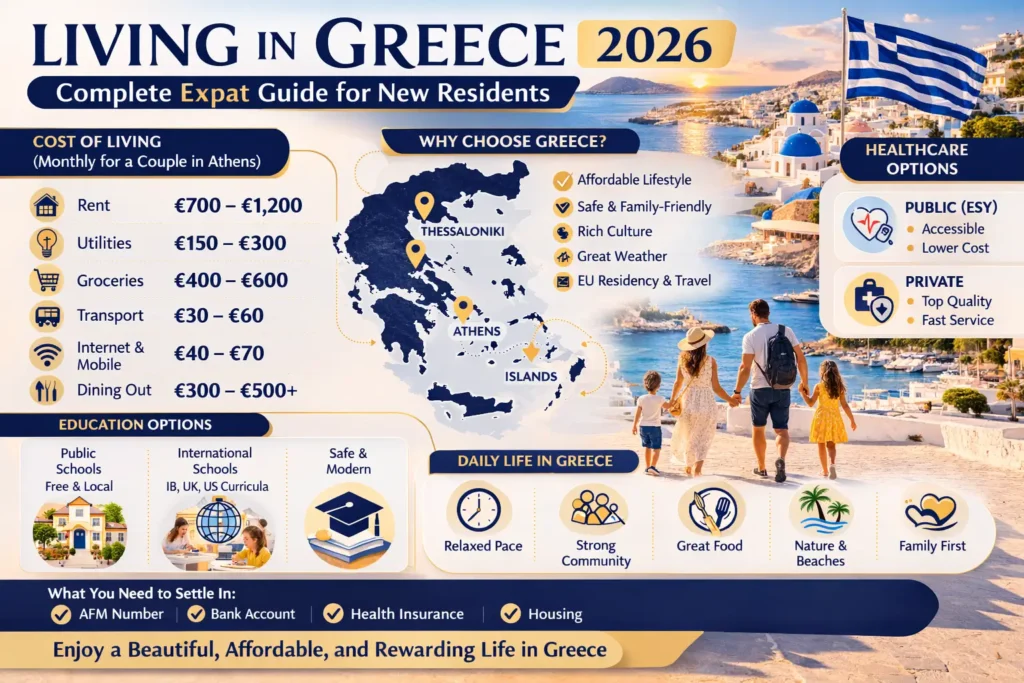
A Snapshot of Monthly Expenses (for a couple in Athens):
| Expense Category | Estimated Monthly Cost | Notes |
| Rent (1-bedroom apt, city center) | €700 – €1,200 | Prices are significantly lower outside the prime central districts. |
| Utilities (Electricity, Heating, Water) | €150 – €300 | Can vary greatly depending on season and usage (heating in winter, A/C in summer). |
| Groceries | €400 – €600 | Shopping at local markets (laiki) can significantly reduce this cost. |
| Transportation (Public Transport Pass) | €30 – €60 per person | Athens has an excellent and affordable metro, bus, and tram system. |
| Internet & Mobile Phone | €40 – €70 | Competitive packages are available from major providers. |
| Eating Out & Entertainment | €300 – €500+ | A coffee costs €3-€4, a casual meal (souvlaki) is €5-€8, and a mid-range restaurant dinner for two is €50-€80. |
| Total Estimated Monthly Budget | €1,600 – €2,700+ | This provides a comfortable lifestyle. Costs can be lower in other cities like Thessaloniki or Patras. |
The Greek Healthcare System: Public and Private Options
As a resident, you will have access to Greece’s healthcare system. It’s important to understand your options:
- Public Healthcare (ESY): The national healthcare system provides universal coverage. As a resident, you can register for a social security number (AMKA), which gives you access to public hospitals and doctors. While the quality of care from medical professionals is high, public facilities can sometimes experience long waiting times and may not have the modern amenities of private hospitals.
- Private Healthcare: This is the preferred option for many expats and Golden Visa holders. All residents are required to have private health insurance to obtain and renew their permits. The private system is excellent, with state-of-the-art hospitals, English-speaking doctors, and virtually no waiting times for appointments and procedures. Costs are very reasonable by international standards, with a comprehensive policy for a family often costing a fraction of what it would in the US.
Housing and Property Choices for New Residents
For many Greece Golden Visa investors, purchasing property is both the pathway to residency and the foundation of their new life in Greece. Housing options vary widely depending on location, lifestyle preferences, and investment goals.
Athens remains the most popular destination due to its international connectivity, strong rental demand, and large expat community. Investors often explore the property market through guides such as to understand neighborhood trends and investment potential.
Northern Greece, particularly Thessaloniki, has also gained significant attention due to strong price growth and a vibrant cultural environment. Investors comparing these two cities can review our analysis in to better understand the different investment profiles.
For those focused specifically on residency-qualified properties, our curated portfolio of highlights investment opportunities that meet program requirements while supporting long-term lifestyle goals.
Education in Greece: Nurturing the Next Generation
For families with children, Greece offers a range of high-quality educational choices.
- Public Schools: Free for all residents, the public system provides a Greek-centric curriculum. While it’s a great way for children to integrate and become fluent in Greek, the language barrier can be a challenge initially for non-Greek-speaking children.
- International Schools: This is the most popular choice for the expat community. Located primarily in and around Athens and Thessaloniki, these schools offer globally recognized curricula, such as the International Baccalaureate (IB), and American or British (GCE A-Level) systems. They provide a multicultural environment and a seamless educational transition for children from other countries.
Prominent International Schools in Athens:
- St. Catherine’s British School
- Campion School
- American Community Schools (ACS) Athens
- International School of Athens (ISA)
Tuition fees for international schools can range from €7,000 to €14,000+ per year, depending on the school and grade level.
Daily Life and Culture: Embracing “Siga-Siga”
To truly enjoy life in Greece, you must embrace its unique cultural rhythm.
- The Concept of “Siga-Siga” (Slowly, Slowly): Life in Greece moves at a more relaxed pace. Punctuality is less rigid, and there is a greater emphasis on enjoying the moment rather than rushing through a schedule. This can be an adjustment, but it’s the source of the country’s famously low-stress lifestyle.
- The Importance of “Filoxenia” (Hospitality): Greeks are incredibly welcoming and generous people. Hospitality is a cornerstone of the culture, and you will often be treated like family by neighbors and local shopkeepers. Making an effort to learn a few Greek phrases will be warmly received and will open many doors.
- Coffee Culture: Coffee is a ritual in Greece, not just a morning habit. Cafes are social hubs where people meet for hours to talk, play backgammon (tavli), and watch the world go by.
- Family First: Family is the bedrock of Greek society. Life revolves around strong family ties, and it’s common for multiple generations to live close to one another and be deeply involved in each other’s lives.
After relocating to Greece, several administrative steps help new residents fully integrate into everyday life. While many investors already complete some of these during their Golden Visa process, understanding how these systems work in practice is important for a smooth transition.
Tax Identification Number (AFM)
Almost every financial or administrative activity in Greece requires a Greek tax number, known as the AFM (Arithmos Forologikou Mitroou). This number is used when signing property contracts, opening bank accounts, and interacting with public services.
If you are investing through the residency program, your lawyer typically helps obtain this number during the early stages of the investment process. A detailed explanation of this requirement is covered in our guide on .
Greek Bank Account
Most residents maintain a local bank account for daily expenses, property payments, and utility bills. Greek banks offer modern online banking platforms and support international transfers, making financial management straightforward for expats.
Opening a local account is also necessary for property transactions under the Golden Visa framework, ensuring compliance with financial transparency rules.
Public Services and Digital Government
Greece has significantly modernized its digital government infrastructure in recent years. Many administrative tasks such as tax filings, document requests, and public service applications can now be completed online through the government portal.
For expats, this modernization has dramatically simplified interactions with Greek bureaucracy compared to previous decades.
Conclusion: A Rich Life Awaits
Living in Greece offers a rare combination of lifestyle quality, cultural richness, and economic accessibility within the European Union. For many investors, the journey begins with obtaining residency through the but quickly evolves into a deeper connection with the country’s communities, traditions, and opportunities.
Understanding the realities of daily life such as healthcare, housing, education, and cultural expectations allows new residents to integrate confidently and enjoy everything Greece has to offer. For those considering the residency pathway or exploring the investment process, our comprehensive provides detailed insights into eligibility, investment strategies, and the full application journey.
Frequently Asked Questions
Do I need to speak Greek to live in Greece?
In major cities and tourist areas, you can get by with English, as many Greeks (especially younger generations) speak it fluently. However, for official paperwork, dealing with public services, and truly integrating into the community, learning at least basic Greek is highly recommended and greatly appreciated.
Is Greece a safe country to live in?
Yes, Greece is considered a very safe country with a low rate of violent crime. Like any major city, Athens has areas where petty crime like pickpocketing can occur, but overall, it is a safe and family-friendly environment.
How is the banking system for expats?
Opening a Greek bank account is a straightforward process for residents. You will need your passport, your Greek tax number (AFM), and proof of address. Major Greek banks offer modern online banking services and have staff who can assist you in English.
What is the best way to get around in Greece?
Within Athens, the public transport system (metro, buses, trams) is excellent and efficient. For traveling between cities and to the islands, Greece has a reliable network of domestic flights, intercity buses (KTEL), and an extensive ferry system, which is a quintessential part of the Greek travel experience.
Do Golden Visa residents automatically become tax residents of Greece?
No. Holding a residence permit does not automatically make you a tax resident. In general terms, tax residency is typically triggered if an individual spends more than 183 days per year in Greece or establishes primary economic ties there. Many Golden Visa investors remain tax residents of their home country while maintaining property and residency rights in Greece.
Can Golden Visa holders live anywhere in Greece?
Yes. Once residency is granted, permit holders are free to live anywhere in the country, whether in major cities like Athens and Thessaloniki, coastal towns, or the Greek islands. The residence permit itself is not restricted to the property location.
Is Greece suitable for retirement relocation?
Greece has become an increasingly popular destination for retirees due to its affordable cost of living, excellent climate, and strong healthcare infrastructure. Many international retirees also explore the option through the Golden Visa program or through relocation pathways such as those explained in our guide on .
Can I rent out my property while living in Greece?
Yes. Property owners are generally allowed to rent their real estate for long-term or short-term stays depending on local regulations and licensing requirements. Rental income can help offset ownership costs and may provide attractive yields in high-demand urban areas.