Greece — +30 698 557 8998
 Egypt — +20 111 3075 444
 Turkey — +90 506 022 30 00
 UAE — +971 52 913 5599





Buying Secondary Market Property in Greece: Why Resale Properties Are Attracting More International Investors
Secondary market property in Greece refers to resale homes that are already owned and may have previously been used for residential, holiday, or investment purposes. For international buyers, this segment of the Greece real estate investment market offers one of the most practical and often more accessible entry points compared to off-plan or newly developed projects. Between 2024 and 2026, buying property in Greece through the secondary market has become increasingly attractive as investors seek immediate availability, established neighborhoods, and clearer pricing structures.
These properties are often located in mature neighborhoods across Greece, including:
- Athens
- Thessaloniki
- Crete
- Chania
- Rethymno
- Agios Nikolaos
- High-demand tourist islands
The appeal of secondary market property Greece is driven by several investor-focused advantages:
- Immediate ownership and faster transaction timelines
- Access to established infrastructure and communities
- Lower price per square meter compared to many new developments
- Potential rental income from day one
- Eligibility for residency through qualifying property investment
For investors exploring Greek residency by investment pathways, resale properties often provide a balanced route between speed, asset quality, and residency strategy.
What Is Secondary Market Property in Greece?
Secondary market property in Greece refers to resale real estate that has been previously owned, unlike primary market properties, which are newly built or sold directly by developers.
Secondary Market Properties Typically Offer:
- Existing ownership history
- Immediate delivery
- Established locations
- Potentially furnished or turnkey options
- Greater price negotiation opportunities
Primary Market Properties Typically Offer:
- New construction
- Developer-led sales
- Premium pricing
- Construction or delivery timelines
- Modern specifications
For investors comparing resale vs new property Greece, the choice often depends on:
Core Strategic Factors:
- Speed
- Risk
- Rental timeline
- Capital allocation
- Renovation appetite
Why Investors Choose Secondary Market Property in Greece
Investors often choose secondary market property Greece for strategic reasons beyond just price.
Key Advantages:
Immediate Rental Income Potential
Especially in high-demand urban or tourism zones.
Established Infrastructure
Buyers can evaluate:
- Transport
- Community quality
- Rental demand
- Real neighborhood conditions
Lower Entry Cost
Many resale properties offer more competitive per-square-meter pricing.
Physical Inspection
Investors can assess actual condition before purchase.
Faster Residency Strategy
For qualifying investments, resale property can often accelerate qualifying Greece Golden Visa properties selection and implementation.
Can Foreigners Buy Secondary Market Property in Greece?
Yes. Greece maintains one of Europe’s more accessible property ownership structures for international investors. Both EU and non-EU nationals can legally purchase secondary market property in Greece with full ownership rights, subject to standard compliance requirements.
Foreign Buyer Advantages:
- Full freehold ownership
- Equal rights for most foreign investors
- Greek legal protection
- Secure title transfer through notarial system
- Registration via Greek Land Registry (Ktimatologio)
Core Requirements Include:
- Greek Tax Identification Number (AFM)
- Legal due diligence
- Greek bank account
- Property registration
For investors buying from the UK, USA, UAE, or Turkey, remote purchase structures through legal representatives are increasingly common.
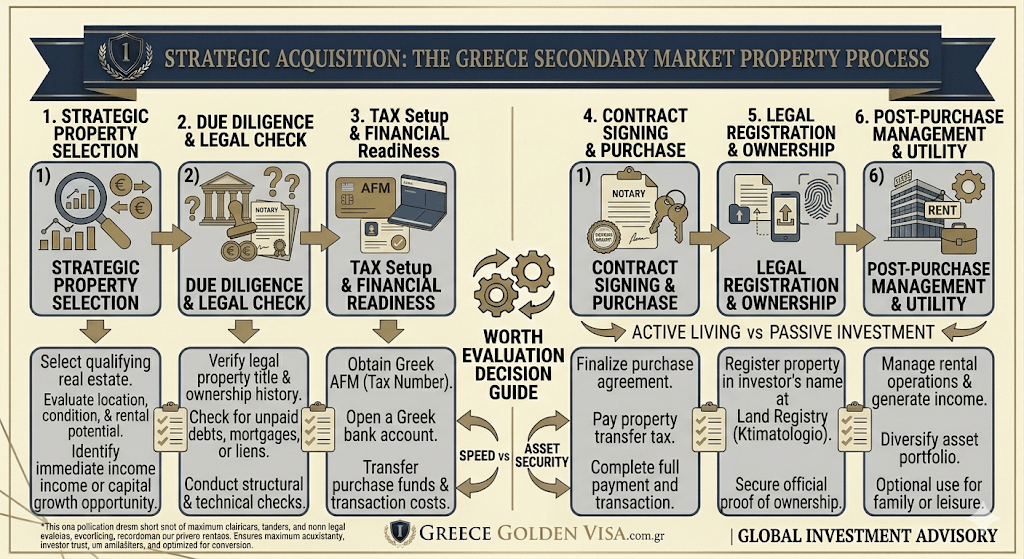
Step-by-Step Process of Buying Secondary Market Property in Greece
The Greek property buying process is structured, but each stage requires precision.
Step 1: Obtain a Greek Tax Number (AFM)
The AFM is mandatory for:
- Purchase agreements
- Banking
- Tax payments
Step 2: Open a Greek Bank Account
This supports:
- Fund transfer
- Tax compliance
- Utility and ownership expenses
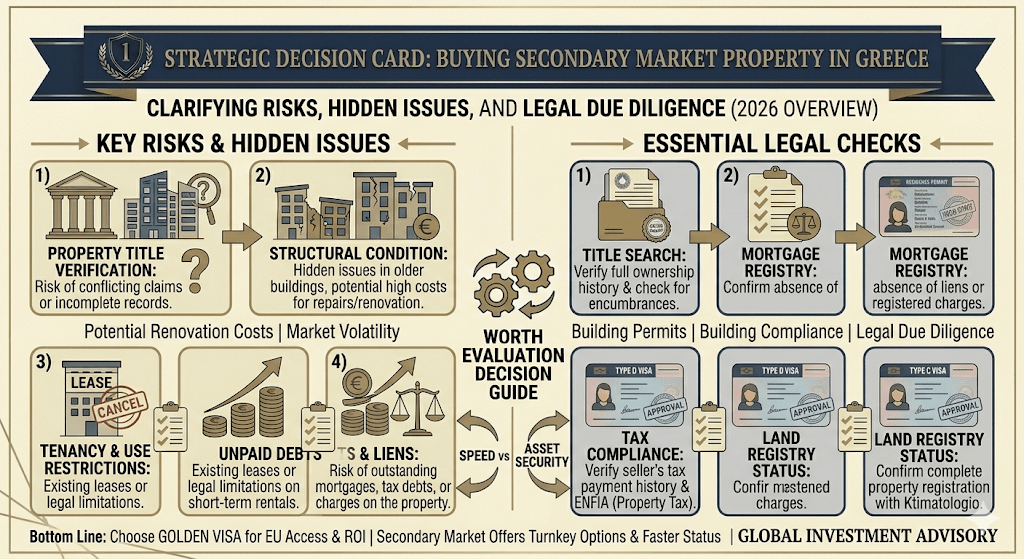
Step 3: Conduct Legal Due Diligence
This is one of the most critical stages.
Legal Checks Should Include:
- Title verification
- Ownership history
- Outstanding mortgages
- Building permits
- Land Registry compliance
- Tax liabilities
For investors also planning Greece Golden Visa legal compliance and documentation strategy, this stage is essential.
Step 4: Sign Before a Greek Notary
The notary ensures:
- Contract legality
- Identity verification
- Formal transfer
Step 5: Register Ownership
Registration with Greek Land Registry finalizes ownership.
Hidden Risks When Buying Resale Property in Greece
While secondary market properties can offer excellent opportunities, hidden issues are one of the most important investor concerns.
Common Hidden Risks Include:
Title Problems
- Ownership disputes
- Encumbrances
- Unregistered changes
Illegal Building Modifications
Unauthorized structural changes can create legal or financing issues.
Renovation Costs
Older properties may require:
- Structural upgrades
- Electrical updates
- Plumbing replacement
- Energy efficiency improvements
Tax and Debt Liabilities
Outstanding obligations may impact transaction security.
Strategic Investor Rule:
Never skip legal due diligence.
Cost of Buying Secondary Market Property in Greece
Understanding total acquisition cost is essential.
Core Cost Layers:
Property Transfer Tax
Typically around 3% for secondary market transactions.
Legal Fees
Varies by complexity.
Notary Fees
Generally 1–2%.
Land Registry Fees
Annual ENFIA Property Tax
Maintenance / Renovation Costs
Strategic Planning Tip:
Minimum purchase price ≠ total investment cost
For broader wealth strategy, investors should also evaluate Greece Golden Visa family wealth planning and backup residency.
Secondary Market Property and the Greece Golden Visa
Secondary market properties play a major role in the Greece Golden Visa Program because they often provide:
- Faster transaction speed
- Immediate title transfer
- Established urban or tourism locations
- Potential rental cash flow
Greece Golden Visa Investment Thresholds (2026)
| Investment Route | Threshold |
|---|---|
| Commercial-to-residential conversion | €250,000 |
| Standard real estate in selected regions | €400,000 |
| Prime zones such as Athens, Thessaloniki | €800,000 |
Strategic Investor Insight:
Resale properties can often align well with both:
Residency + yield
Best Locations to Buy Secondary Market Property in Greece
Athens
Best For:
- Liquidity
- Golden Visa demand
- Long-term rental
Thessaloniki
Best For:
- Lower entry
- Student rental
- Growth potential
For investors comparing Athens vs Thessaloniki investment strategy, both cities offer distinct profiles.
Crete
Best For:
- Lifestyle + tourism
- Mid-range entry
- Growth through infrastructure
Chania / Rethymno
Best For:
- Holiday rentals
- Tourism demand
- Renovation upside
Agios Nikolaos
Best For:
- Premium coastal positioning
- Luxury second homes
How Infrastructure Projects Are Changing Secondary Property Markets
Large-scale infrastructure, especially in Crete, is increasingly reshaping local property values.
Major Projects Include:
- Kastelli Airport
- Heraklion Airport upgrades
- Chania International improvements
Strategic Effects:
- Increased tourism
- Improved accessibility
- Higher rental demand
- Potential capital appreciation
Final Verdict: Is Buying Secondary Market Property in Greece a Good Investment?
For many investors, yes — but only with proper legal diligence.
Secondary Market Property Often Makes Sense If You Prioritize:
- Immediate property access
- Rental income speed
- Lower pricing
- Golden Visa strategy
- Established neighborhoods
- Negotiation opportunities
It May Be Especially Strong For:
- Golden Visa investors
- Rental-focused buyers
- Lifestyle investors
- UK / US / UAE / Turkish buyers
Bottom Line:
Buying secondary market property in Greece can be one of the most practical and strategically efficient ways to secure:
Greek real estate + EU residency + rental potential
But success depends heavily on:
Legal verification + title security + renovation analysis + strategic location selection
Frequently Asked Questions (FAQ)
Can foreigners buy secondary market property in Greece?
Yes. Greece allows foreign ownership with legal compliance.
Does resale property qualify for the Greece Golden Visa?
Yes, if the investment meets applicable thresholds.
What is the biggest risk?
Title issues, hidden legal liabilities, and renovation costs.
Is resale property cheaper than new developments?
Often yes, especially per square meter.
Can I buy remotely?
Yes. Many investors use power of attorney and legal representatives.