Greece — +30 698 557 8998
 Egypt — +20 111 3075 444
 Turkey — +90 506 022 30 00
 UAE — +971 52 913 5599





Why Greece Is Becoming a Top Retirement Destination in Europe
Retiring in Greece has become one of the most strategic lifestyle and residency decisions for international retirees in 2026.
Greece offers a rare combination of:
- Mediterranean lifestyle
- Lower cost of living than much of Western Europe
- European Union residency access
- Real estate investment opportunities
- Long-term relocation flexibility
- Potential tax advantages
For many retirees, Greece is no longer simply a lifestyle destination. It is increasingly viewed as a broader strategic relocation plan that combines quality of life with residency and wealth positioning.
According to GreeceGoldenVisa.com.gr, retirees increasingly evaluate Greece through both:
- Lifestyle relocation
- Property-backed residency
- Tax planning
- Family strategy
Overview of Retirement in Greece
Greece combines climate, affordability, and strategic geographic location.
Key Retirement Advantages Include:
- Schengen Area mobility
- European residency
- Mediterranean climate
- Established expat communities
- Strong healthcare options
- Flexible residency structures
This makes Greece especially attractive for retirees from:
- United Kingdom
- United States
- Turkey
- UAE
- Canada
- Other non-EU jurisdictions
The Mediterranean Lifestyle Advantage
One of Greece’s strongest retirement appeals is its lifestyle.
Lifestyle Benefits Include:
- Over 300 days of sunshine annually
- Coastal living
- Island options
- Mediterranean diet
- Slower pace of life
- Family-oriented social culture
For retirees seeking healthier and less stressful living, this environment is often a major driver.
Urban vs Island Retirement
Retirees may choose:
Athens:
- Urban infrastructure
- Healthcare
- International services
- Investment opportunities
Crete / Islands:
- Slower pace
- Nature
- Coastal living
- Lifestyle focus
This flexibility allows Greece to suit multiple retirement profiles.
Greece as a Strategic European Base
Because Greece is part of the European Union and Schengen Area, residency may offer broader strategic benefits.
Residency May Provide:
- Visa-free Schengen travel
- Long-term EU access
- Stable political environment
- Banking access
- Healthcare infrastructure
- Family inclusion
For non-EU retirees, this can be particularly significant.
Can Foreigners Retire in Greece?
Yes, foreigners can legally retire in Greece through structured residency pathways.
Retirement for EU Citizens
EU citizens generally benefit from freedom of movement.
Typical Requirements Include:
- Residence registration
- Proof of financial means
- Health insurance
Retirement for Non-EU Citizens
Non-EU retirees generally need a residence permit.
Main Pathways Include:
- Financially Independent Person (FIP) Visa
- Greece Golden Visa Program
These two routes differ significantly depending on whether the retiree prioritizes:
- Passive income
- Property investment
- Flexibility
- Long-term asset ownership
Residency Options for Retiring in Greece
Choosing the right residency structure is one of the most important retirement decisions.
Financially Independent Person (FIP) Visa Greece
The FIP Visa is commonly considered Greece’s retirement visa.
Main Purpose:
Designed for retirees with stable passive income who do not need to work in Greece.
Key FIP Visa Requirements:
- Proof of passive income from abroad
- Usually around €2,000+ monthly for single applicants
- Private health insurance
- Clean criminal record
- Proof of accommodation
Advantages:
- No property purchase required
- Income-based pathway
- Straightforward retirement option
Limitations:
- Physical presence requirement
- Income verification
- Less flexibility than Golden Visa
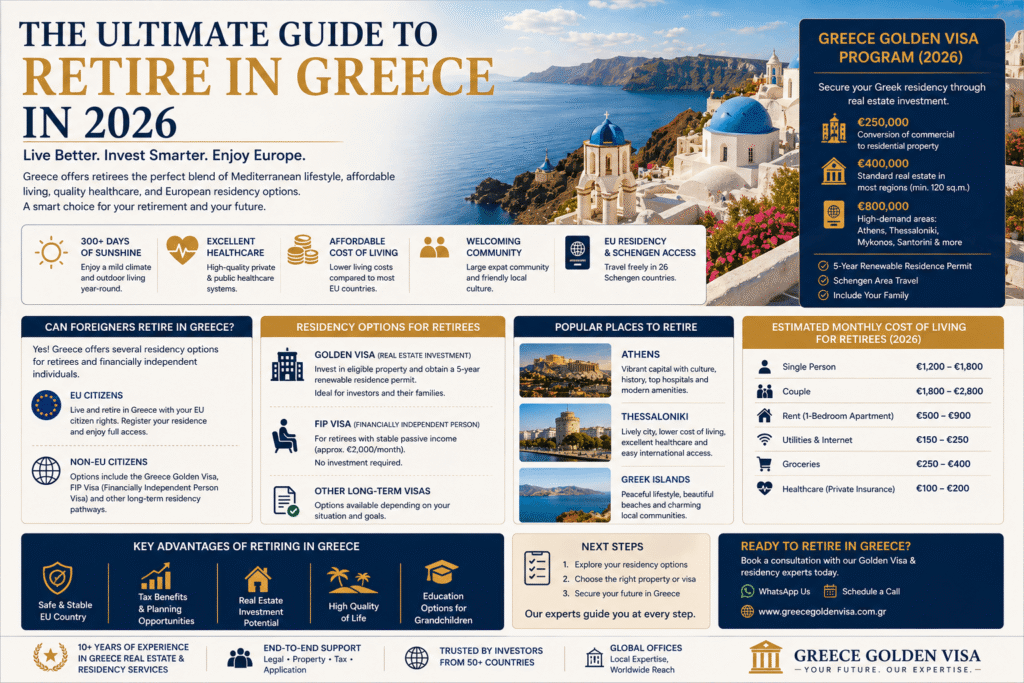
Greece Golden Visa Program for Retirees
The Greece Golden Visa Program is often the preferred route for retirees seeking both residency and property ownership.
Greece Golden Visa Investment Options (2026)
| Investment Threshold | Main Category |
|---|---|
| €250,000 | Commercial-to-residential conversions |
| €400,000 | Standard real estate in many regions |
| €800,000 | Prime zones such as Athens, Thessaloniki, Santorini |
Main Benefits:
- 5-year renewable residence permit
- No minimum stay requirement
- Family inclusion
- Schengen mobility
- Real estate ownership
- Potential long-term capital growth
For many retirees, this creates both residency and asset diversification.
If you are evaluating long-term retirement through investment, exploring Greece Golden Visa properties may help align location, budget, and retirement goals.
FIP Visa vs Greece Golden Visa
Choosing between these options depends on financial profile.
Core Comparison:
| Feature | FIP Visa | Greece Golden Visa |
|---|---|---|
| Main Qualification | Passive income | Property investment |
| Investment Required | No | Yes |
| Physical Stay Requirement | Yes | No minimum stay |
| Asset Ownership | Optional | Required |
| Flexibility | Moderate | High |
Best For:
FIP Visa:
- Pensioners
- Passive income retirees
- Full-time Greece residents
Golden Visa:
- Investors
- Flexible retirees
- Multi-country retirees
- Wealth preservation
Cost of Living in Greece for Retirees
Greece remains more affordable than many Western European countries.
Housing Costs
Housing costs vary by region.
Athens:
- Broad property range
- Urban convenience
- Higher than many secondary regions
Thessaloniki:
- More affordable city living
Islands:
- Premium in Santorini/Mykonos
- More balanced in Crete or Rhodes
Strategic Decision:
Retirees must choose between:
- Renting for flexibility
- Buying for stability or Golden Visa eligibility
Everyday Expenses
Common Living Costs Include:
- Food
- Utilities
- Transport
- Dining
- Domestic travel
Many retirees find Greece’s daily expenses manageable compared with Western Europe.
Healthcare in Greece for Retirees
Healthcare is a critical retirement consideration.
Greek National Health System (ESY)
Public healthcare offers:
- Hospitals
- Clinics
- Basic medical care
- Emergency treatment
Pros:
- Lower cost
- Broad access
Cons:
- Potential waiting times
Private Healthcare
Private healthcare is widely used by retirees.
Advantages Include:
- Faster access
- English-speaking specialists
- Modern clinics
- International-level services
Strategic Insight:
Many retirees use private healthcare for convenience while retaining public system access where eligible.
Health Insurance Requirements
Both FIP and Golden Visa structures generally require valid health insurance.
Common Requirements:
- Inpatient care
- Outpatient care
- Emergency coverage
- Compliance with residency standards
Taxes for Retirees Living in Greece
Tax planning can significantly affect retirement outcomes.
Tax Residency Rules
A retiree may generally become a Greek tax resident if:
- Spending more than 183 days annually in Greece
- Establishing primary economic ties
Greece’s Special Tax Regime for Foreign Retirees
Greece offers a special retiree tax framework.
Main Benefit:
- 7% flat tax on foreign income (under qualifying conditions)
This can be highly attractive for retirees from high-tax jurisdictions.
Foreign Pension Taxation
Taxation depends on:
- Residency status
- Double taxation treaties
- Pension source
- Legal structuring
Professional tax planning is especially important.
Banking and Financial Setup
Retirees relocating to Greece generally need financial infrastructure.
Key Steps:
- Obtain AFM
- Open Greek bank account
- Structure international transfers
- Plan currency strategy
Important Considerations:
- Exchange rates
- Compliance
- Source of funds
- Property payments
Best Places to Retire in Greece
Location choice shapes retirement quality.
Athens
Best For:
- Healthcare
- Infrastructure
- International community
- Property investment
Crete
Best For:
- Balanced lifestyle
- Climate
- Expat communities
- Lower volatility
Thessaloniki
Best For:
- Lower urban cost
- Cultural lifestyle
- City living
Santorini / Mykonos
Best For:
- Luxury retirement
- Prestige
- Lifestyle
Caution:
- Higher cost
- Tourism intensity
Corfu
Best For:
- UK expat familiarity
- Green landscapes
- Coastal living
Rhodes
Best For:
- Infrastructure
- History
- Balanced island life
Pros and Cons of Retiring in Greece
Main Advantages
Mediterranean Climate:
- Sunshine
- Outdoor lifestyle
- Coastal access
Lifestyle:
- Culture
- Food
- Community
Strategic Residency:
- EU access
- Schengen mobility
- Golden Visa options
Investment Opportunity:
- Real estate
- Residency
- Potential capital appreciation
Main Challenges
Language Barrier:
Greek may complicate bureaucracy outside major expat zones.
Bureaucracy:
Administrative procedures can be complex.
Seasonal Tourism:
Crowding in tourist-heavy regions.
Pathway to Long-Term Residency and Citizenship
For many retirees, Greece may become a long-term EU strategy.
Golden Visa:
- Renewable indefinitely if compliant
- No minimum stay for permit retention
FIP Visa:
- Ongoing physical presence requirements
Citizenship Pathway
Greek citizenship through naturalization may generally require:
- 7 years legal residence
- Integration
- Language and civic exams
Important:
Golden Visa does not automatically grant citizenship, but it may support a pathway depending on actual residency.
Final Thoughts: Is Greece a Good Place to Retire in 2026?
For many retirees, Greece offers one of Europe’s strongest combinations of:
- Lifestyle
- Residency
- Investment
- Healthcare
- Climate
- EU positioning
The best residency route depends on whether you prioritize:
FIP Visa:
Income-based retirement
Greece Golden Visa:
Property-backed flexibility and long-term strategic value
For retirees who want to combine lifestyle with real estate, residency, and broader wealth planning, Greece increasingly stands out.
Frequently Asked Questions About Retiring in Greece
How much money do you need to retire in Greece?
This depends on lifestyle and residency route. FIP Visa applicants often need around €2,000+ monthly passive income, while Golden Visa investors qualify through property investment.
What is the best visa for retirees in Greece?
For passive-income retirees, the FIP Visa may suit best. For investors seeking flexibility and property ownership, the Greece Golden Visa is often more strategic.
Is Greece affordable for retirees?
Compared with much of Western Europe, Greece is often considered relatively affordable, though premium islands can be expensive.
Can retirees get healthcare in Greece?
Yes. Greece offers both public and private healthcare options.
Can foreigners buy property in Greece to retire?
Yes. Many retirees purchase Greek property, often through broader Golden Visa planning.
Is Greece a tax-friendly retirement destination?
For some retirees, yes, especially through Greece’s 7% retiree tax regime or broader tax planning strategies.
Can Greece Golden Visa lead to citizenship?
Not directly, but long-term legal residence may support future naturalization eligibility.