Greece — +30 698 557 8998
 Egypt — +20 111 3075 444
 Turkey — +90 506 022 30 00
 UAE — +971 52 913 5599





Overview of Property Taxes in Greece
Property taxes in Greece are a major consideration for any foreign investor evaluating Greek real estate investment or the Greece Golden Visa Program.
Understanding tax obligations at every stage of ownership helps investors:
- Calculate true ROI
- Avoid unexpected costs
- Structure investments efficiently
- Protect long-term profitability
- Improve exit strategy
The Greek property tax system generally operates across three stages:
- Acquisition taxes when buying
- Annual taxes during ownership
- Exit taxes when selling or transferring
According to GreeceGoldenVisa.com.gr, investors should evaluate not only purchase price and Golden Visa eligibility, but also long-term tax exposure.
Understanding the Greek Property Tax Framework
The Greek property tax system is regulated by the Independent Authority for Public Revenue and applies to both residents and non-residents.
Main Property Taxes in Greece Include:
- Property Transfer Tax
- VAT in certain new-build scenarios
- ENFIA (Unified Property Tax)
- Municipal TAP tax
- Rental income tax
- Capital gains considerations
- Inheritance and gift taxes
The Greece Golden Visa Program is directly linked to property ownership, meaning Golden Visa investors must fully comply with the same tax obligations as other property owners.
Why Greece’s Tax Framework Matters
Taxes directly affect:
- Net rental yield
- Holding cost
- Liquidity
- Exit timing
- Portfolio efficiency
For example, investors buying Greece Golden Visa properties in Athens, Thessaloniki, or high-demand islands must evaluate not only appreciation but also:
- Progressive rental taxation
- ENFIA
- Municipal charges
- Short-term rental restrictions
- Compliance reporting
This makes tax planning a critical part of Greece residency by investment strategy.
Who Must Pay Property Taxes in Greece?
There is generally no tax exemption for foreign investors simply because they are non-residents.
Property Tax Obligations Apply To:
- Non-EU investors
- EU investors
- Greece Golden Visa holders
- Foreign individuals
- Corporate owners
Typical Requirements Include:
- Obtaining a Greek Tax Identification Number (AFM)
- Filing tax declarations
- Paying ENFIA annually
- Declaring rental income where applicable
- Maintaining tax compliance
The Greece Golden Visa Program provides residency benefits, but it does not reduce standard Greek property tax obligations.
Taxes When Buying Property in Greece
When purchasing property, total acquisition cost extends beyond the property price itself.
Typical Buying Costs Include:
- Property Transfer Tax
- Notary fees
- Legal fees
- Land Registry / Cadastre fees
- Administrative and translation costs
This is especially important for investors calculating true Greece Golden Visa cost.
Property Transfer Tax in Greece
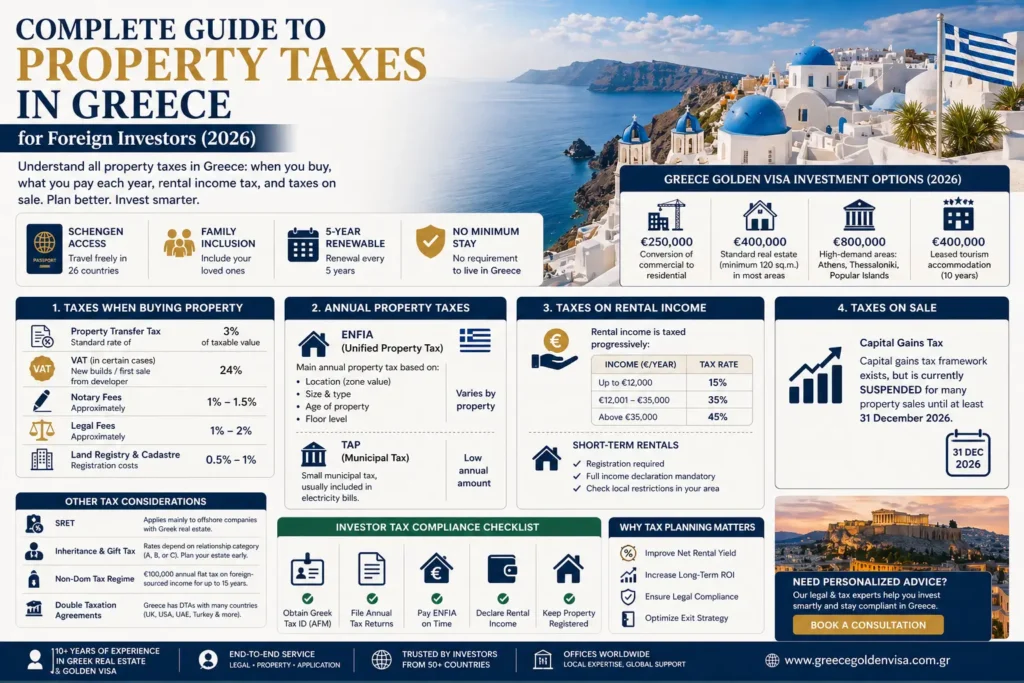
The standard property transfer tax in Greece is typically around 3% of the property’s taxable value.
Key Characteristics:
- Usually applies to resale properties
- Paid before final contract execution
- Based on taxable value
- Required for legal transfer
VAT Considerations
VAT (often 24%) may apply instead of transfer tax in certain cases, especially:
- Newly built properties
- First-time sales from developers
Because of this, many investors strategically favor resale properties to reduce acquisition tax burden.
Greece Golden Visa Investment Thresholds (2026)
| Investment Threshold | Main Category |
|---|---|
| €250,000 | Conversion projects |
| €400,000 | Standard real estate in many regions |
| €800,000 | Prime zones such as Athens and Thessaloniki |
Investors should calculate tax and transaction costs on top of these thresholds.
Notary, Legal, and Registration Fees
In Greece, property purchases require legal and notarial structure.
Typical Cost Ranges:
- Notary fees: ~1%–1.5%
- Legal fees: ~1%–2%
- Translation and administration: Variable
- Registry fees: ~0.5%–1%
Why These Costs Matter
They support:
- Legal due diligence
- Title verification
- Contract execution
- Greek Land Registry compliance
- Golden Visa eligibility
Foreign investors should never treat these as optional.
For investors comparing full acquisition cost, property due diligence for the Greece Golden Visa remains essential before purchase.
Land Registry and Cadastre Registration Costs
After purchase, property must be formally registered.
Registration Supports:
- Legal ownership confirmation
- Golden Visa application compliance
- Tax clarity
- Future resale security
Typical Cost:
- Approximately 0.5%–1%
Improper registration may create legal complications and residency delays.
Annual Property Taxes in Greece
Owning property in Greece creates recurring annual obligations.
Main Annual Taxes Include:
- ENFIA
- TAP (municipal tax)
These taxes affect:
- Net yield
- Holding cost
- Long-term ROI
ENFIA – Greece’s Main Annual Property Tax
ENFIA is the primary recurring annual property tax.
ENFIA Calculation Factors:
- Property location
- Zone value
- Square meters
- Age
- Floor level
- Property type
Investor Insight
ENFIA is generally considered moderate relative to many Western European jurisdictions, which supports Greece’s attractiveness.
ENFIA applies to:
- Individuals
- Companies
- Golden Visa investors
- Foreign owners
TAP – Municipal Property Tax
TAP is a smaller municipal charge typically billed through electricity.
Key Features:
- Mandatory
- Local authority based
- Usually low
- Ongoing
Although minor compared to ENFIA, it still matters for full cost planning.
Rental Income Tax for Property Owners in Greece
Rental income is one of the primary return drivers for Greek property investors.
However, tax planning is essential because rental income is taxed progressively.
Rental Income Tax Rates
Current Tax Brackets:
| Rental Income | Tax Rate |
|---|---|
| Up to €12,000 | 15% |
| €12,001–€35,000 | 35% |
| Above €35,000 | 45% |
Key Investor Implications
- Applies to foreign and domestic investors
- High-income rentals may face significant taxation
- Tax planning directly impacts real net yield
This is especially relevant for Athens and Thessaloniki investors focused on high-demand rental zones.
Short-Term Rental Taxation
Short-term rental income follows tax obligations and compliance requirements.
Key Requirements:
- Registration in official registry
- Income declaration
- Compliance with property use laws
Important Golden Visa Consideration
Certain Greece Golden Visa properties may face restrictions on Airbnb or short-term rentals depending on property type or zone.
This means investors must evaluate rental strategy before acquisition, not after.
Reporting Rental Income to Greek Tax Authorities
Foreign investors typically must:
- Obtain AFM
- Register property
- Declare rental contracts
- File annual tax returns
Risks of Non-Compliance:
- Fines
- Audits
- Legal issues
- Residency complications
Professional tax support is strongly recommended.
Capital Gains Tax on Property Sales
Capital gains tax affects investor exit strategy.
Core Principle:
Tax generally applies to profit from property sale.
Temporary Suspension of Capital Gains Tax
One of Greece’s strongest investor advantages is that capital gains tax remains suspended for many property sales until at least the end of 2026.
Strategic Benefits:
- Potentially stronger net exit returns
- Greater market liquidity
- Competitive European advantage
This policy can materially improve investment profitability.
Tax Considerations When Selling
Even during suspension, investors should still evaluate:
- Market cycle
- Currency risk
- Agent fees
- Legal fees
- Policy timing
Selling during favorable regulatory periods may materially improve ROI.
Special Tax on Real Estate (SRET)
SRET primarily targets certain corporate structures.
Usually Relevant For:
- Offshore companies
- Opaque ownership structures
- Certain legal entities
Most Individual Golden Visa Investors:
Typically unaffected when buying under personal ownership.
However, HNWIs using complex corporate ownership should seek specialist advice.
Inheritance and Gift Taxes on Greek Property
For long-term investors, estate planning matters.
Tax Variables Include:
- Family relationship
- Property value
- Transfer structure
Key Strategic Insight
Close family members often benefit from more favorable treatment than distant relatives.
Greek property can function as both an investment and intergenerational asset if structured properly.
Special Tax Regimes for Foreign Investors
Greece offers strategic regimes for some investors.
Greece Non-Dom Tax Regime
Main Features:
- €100,000 flat annual tax on foreign income
- Up to 15 years
- Additional family inclusion options
Potential Benefits:
- Tax efficiency
- Global income planning
- Residency flexibility
This can complement broader Greece Golden Visa strategy for certain HNWIs.
Double Taxation Agreements (DTAs)
Greece has tax treaties with many jurisdictions, including:
- United Kingdom
- United States
- UAE
- Turkey
Key Benefits:
- Avoid double taxation
- Clarify taxing rights
- Improve tax efficiency
This is particularly relevant for internationally mobile investors.
Property Taxes for Greece Golden Visa Investors
Golden Visa investors generally pay the same tax framework as any property owner.
Main Obligations:
- Transfer tax
- ENFIA
- TAP
- Rental income tax
- Tax filings
Important Clarification:
The Greece Golden Visa Program is a residency solution, not a tax exemption structure.
Tax Planning Strategies for Golden Visa Investors
Strong investors often optimize through:
- Property location selection
- Rental model choice
- Ownership structure
- Exit timing
- DTA awareness
According to GreeceGoldenVisa.com.gr, integrating property selection, residency planning, and tax strategy usually produces stronger long-term outcomes.
Payment Procedures and Tax Compliance
Common Compliance Needs:
- AFM
- Tax filing
- Payment deadlines
- Rental declarations
- Record keeping
Common Payment Methods:
- Greek bank
- Online banking
- Accountants
- Tax representatives
For non-residents, professional support often simplifies compliance significantly.
Strategic Opportunities for Investors
Taxation should not only be viewed as a cost.
It also shapes:
- Yield quality
- Portfolio efficiency
- Exit value
- Family planning
- Long-term residency strategy
The most successful investors often evaluate:
- Tax burden
- Appreciation
- Rental yield
- Compliance
- Liquidity
Final Thoughts: Is Greece Tax-Efficient for Foreign Property Investors?
Compared with many European markets, Greece can remain attractive because of:
- Moderate annual taxation
- Golden Visa access
- Capital gains suspension
- Strong tourism
- Strategic location
- Broad investor demand
However, successful investment depends on informed tax planning, legal due diligence, and strategic property selection.
For investors evaluating Greek real estate through residency, rental, or portfolio strategy, tax should be considered part of the investment itself, not an afterthought.
Frequently Asked Questions About Property Taxes in Greece
What property taxes do foreign investors pay in Greece?
Foreign investors generally pay transfer tax when buying, ENFIA annually, municipal taxes, and rental income tax if generating rental revenue.
What is ENFIA in Greece?
ENFIA is Greece’s main annual property tax based on property characteristics and location.
Do foreigners pay rental income tax in Greece?
Yes, rental income generated in Greece is taxable regardless of investor residency.
Is there capital gains tax on Greek property sales?
Capital gains tax exists in principle, but it is currently suspended for many transactions through at least 2026.
How much is property transfer tax in Greece?
Typically around 3% of taxable value, though VAT may apply in some scenarios.
Do Golden Visa investors pay property taxes?
Yes, Golden Visa investors generally follow standard Greek property tax rules.
Do foreigners need to file tax returns in Greece if they own property?
Yes, especially where rental income or broader tax obligations apply.